- Turning big ideas into great products
- +234 706 495 6005

- Export License No.RN 0003919
-
Opening HoursMON-SAT 8AM-6PM
- Call Us+234 706 495 6005
Car Importation Business In Nigeria: How To Import & Sell Cars | Gavi Global: Supply & Export Of Solid Minerals, Agri-Products, Oil & Gas...
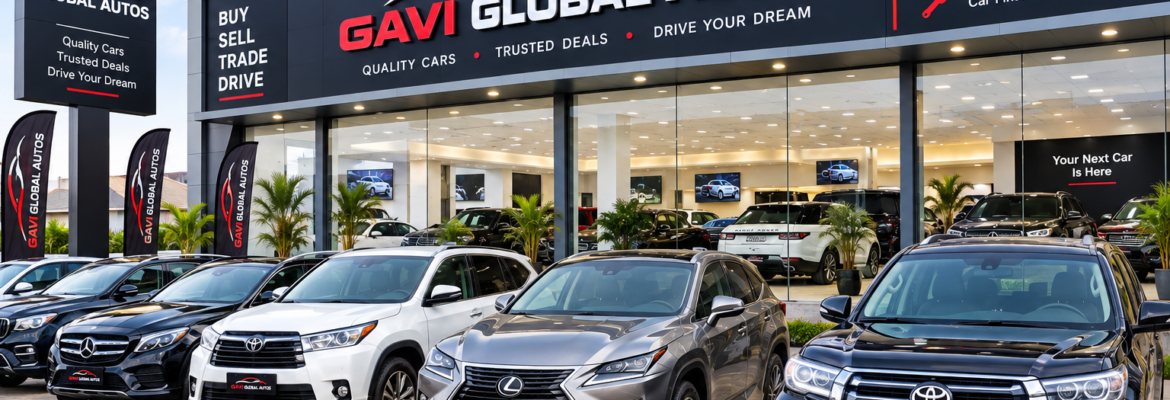
Car Importation Business in Nigeria: How to Start, Import Cars and Make Money Selling Cars
How importing my first Tokunbo car from the United States opened my eyes to a business opportunity that many Nigerians know little about.
If you are searching for a car importation business in Nigeria, wondering how to become a car dealer, or looking for practical ways to make money selling cars in Nigeria, you may be surprised by how many different opportunities exist within the automobile industry.
For years, I assumed that becoming a successful car dealer required enormous capital, a large showroom, and dozens of vehicles sitting on a car lot.
After importing my first Tokunbo car from the United States, I discovered that the business is much broader than simply buying cars and selling them.
You can import vehicles for your own inventory, source cars for customers, sell vehicles on commission, work as a vehicle broker, partner with existing dealerships, or gradually build your own car dealership.
In other words, you don’t necessarily have to start by owning a large fleet of vehicles.
My first experience importing a car changed the way I looked at the Nigerian automobile business. It introduced me to opportunities I had never considered and taught me that knowledge, relationships, marketing, negotiation and trust can be just as important as capital.
This guide explains how the car business in Nigeria works, how to start a car dealership with little capital, how to import cars from the USA to Nigeria, where Nigerians import cars from, and the different ways you can make money selling cars.
Is the Car Importation Business Profitable in Nigeria?
The car importation business in Nigeria can be profitable, but profitability is not automatic.
Your results can depend on the vehicle you purchase, purchase price, exchange rate, shipping cost, customs duties and other import charges, repairs, market demand, selling price and how efficiently you manage the entire transaction.
The biggest mistake a beginner can make is looking only at the purchase price of a vehicle.
For example, a car purchased cheaply overseas may not necessarily be profitable after adding:
- Auction or dealer fees
- Inland transportation
- Shipping
- Insurance
- Port charges
- Customs duties and taxes
- Clearing expenses
- Repairs
- Registration
- Local transportation
- Marketing
- Financing or other business costs
This is why experienced importers calculate the total landed cost before purchasing a vehicle.
The basic calculation is:
Expected selling price − total landed cost = estimated gross margin
Even then, the estimated margin is not guaranteed profit because unexpected repairs, storage, price negotiations and other expenses can reduce the final amount.
The opportunity is therefore not simply about buying cheap cars. It is about buying the right vehicle at the right total cost and finding the right market for it.
My Experience Importing My First Tokunbo Car
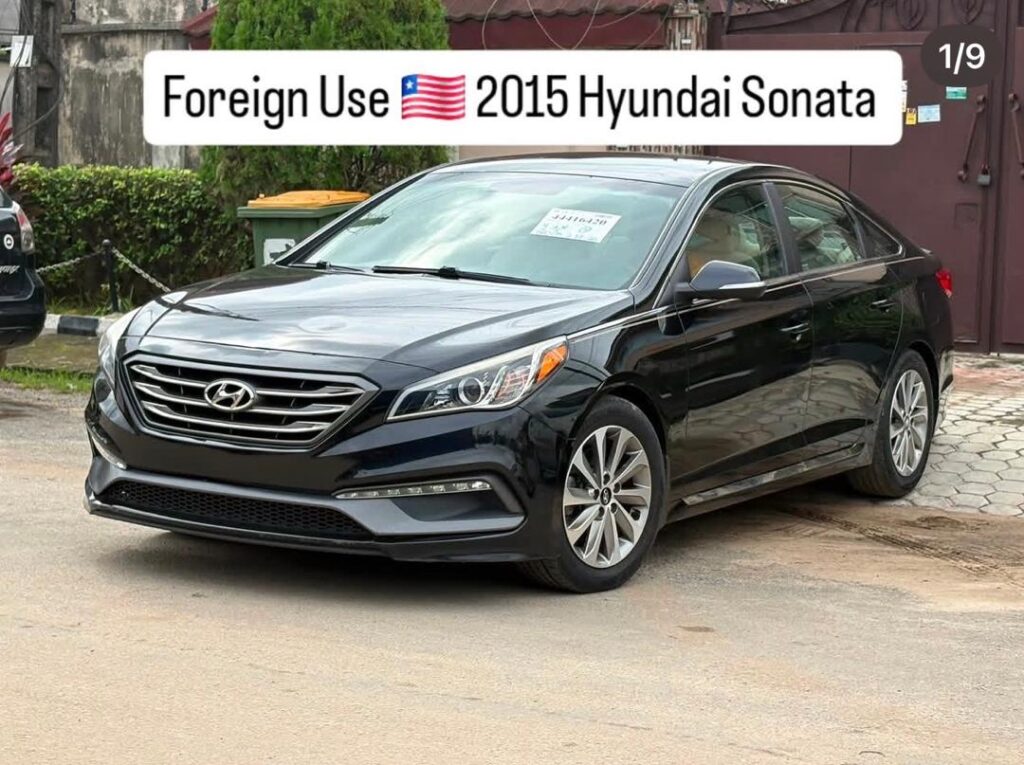 Like many entrepreneurs, I am always interested in business opportunities that solve real problems while offering room for long-term growth.
The Nigerian automobile market immediately caught my attention because people constantly need vehicles for personal, family, commercial, and business purposes.
I decided to import my first Tokunbo vehicle from the United States.
My intention wasn’t simply to buy a car and hope that somebody would eventually purchase it.
I wanted to understand the business from the inside.
I wanted to experience the process of sourcing a vehicle overseas, arranging shipping, clearing the vehicle in Nigeria and eventually putting it on the market.
But the most interesting part of the experience happened after the car arrived.
It was while trying to sell the vehicle that I discovered just how many different ways people participate in the automobile business.
The Discovery That Changed How I Viewed the Car Business
When my vehicle arrived in Nigeria, I started looking for the best way to sell it.
That led me to several car dealers and dealerships.
One thing immediately caught my attention.
Some dealerships had dozens of vehicles displayed for sale.
My first assumption was that the owners had invested enormous amounts of money buying every vehicle on the lot.
Then I started asking questions.
I discovered that some dealers market vehicles that they do not personally own.
A vehicle owner may give a dealership permission to market the car.
The dealer may photograph it, advertise it, show it to prospective buyers, arrange inspections and negotiate the transaction.
Depending on the agreement, the dealer may earn a fixed commission or make money from the difference between the owner’s agreed amount and the final selling price.
This is often referred to as consignment or commission-based vehicle sales, although the exact arrangement varies between businesses.
That discovery completely changed my understanding of the automobile industry.
I realized that the business isn’t only about having money to purchase vehicles.
It is also about:
- Finding vehicles
- Finding buyers
- Marketing
- Negotiation
- Customer service
- Networking
- Vehicle knowledge
- Trust
Many Cars on Display May Not Belong to the Dealership
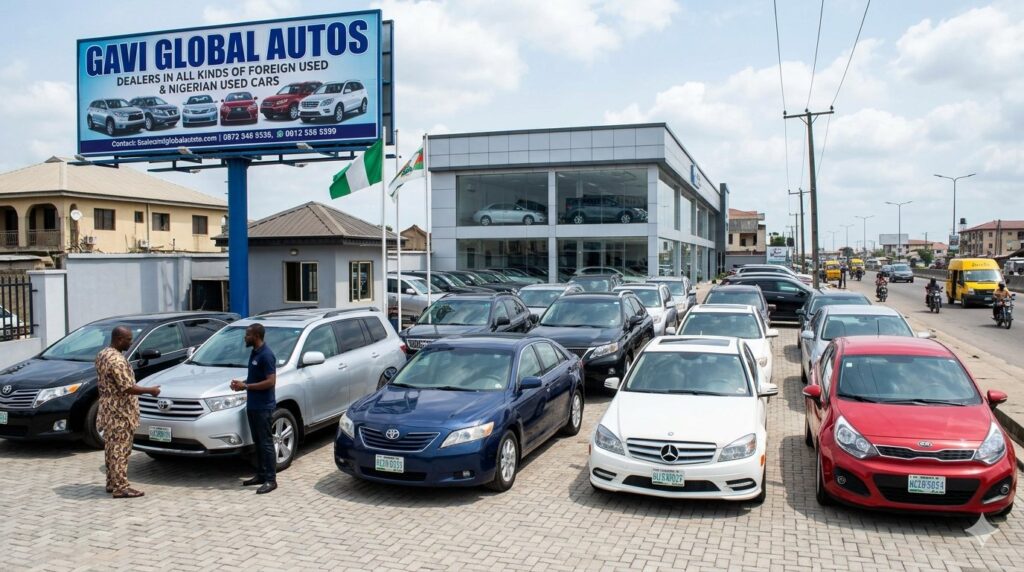 This became even clearer when I decided to leave my own vehicle with a dealership for marketing.
I told the dealer the amount I expected to receive from the sale.
They agreed to display and market the vehicle, respond to potential customers and negotiate with interested buyers.
If the vehicle was sold above the agreed amount, the dealer could earn the agreed difference or commission, depending on our arrangement.
The experience showed me that there are different ways to participate in the car dealership business in Nigeria.
You don’t necessarily have to purchase every vehicle before you can start selling cars.
Of course, arrangements differ between dealerships, and anyone entering this business should clearly document ownership, pricing, commission, responsibilities, insurance, custody of the vehicle and what happens if the car is not sold.
But the larger lesson is important:
Inventory ownership is only one part of the automobile business.
How the Car Business in Nigeria Works
There are several ways to make money in the Nigerian automobile industry.
The right model for you depends on your capital, experience, connections, risk tolerance and long-term goals.
Here are some of the most common models.
1. Importing Cars and Selling Them
This is the traditional model most people think about when they hear car importation business in Nigeria.
You purchase a vehicle abroad, arrange transportation to Nigeria, clear it and sell it locally.
The potential advantage is that you have greater control over the vehicle, pricing and sales process.
However, this model also requires more capital because you carry the financial responsibility for the vehicle and associated importation costs.
2. Selling Cars on Commission
Commission-based selling can provide an entry point for people with limited capital.
A vehicle owner may give you permission to market their car.
You find potential buyers, advertise the vehicle, arrange viewings and assist with negotiations.
You then receive an agreed commission when the transaction is completed.
This model can reduce the amount of capital required because you aren’t necessarily purchasing the vehicle yourself.
However, you still need marketing skills, customer relationships and a clear agreement with the vehicle owner.
3. Becoming a Vehicle Broker
A vehicle broker primarily connects buyers and sellers.
For example, a customer may tell you:
“I am looking for a clean Toyota Camry within my budget.”
You can use your network of dealers, importers and vehicle owners to identify suitable options.
If the buyer completes the transaction, you receive an agreed brokerage fee or commission.
This model can be attractive to entrepreneurs who are good at networking and negotiation.
4. Becoming a Car Sourcing Agent
A sourcing agent helps customers find specific vehicles.
A customer might want:
- A particular make
- A specific model
- A particular year
- A preferred colour
- A specific trim
- Low mileage
- A defined budget
You then search for suitable vehicles and help the customer through the purchasing and importation process.
You may charge a sourcing fee, service fee or agreed margin.
As your reputation grows, referrals can become an important source of customers.
How to Start a Car Dealership Business With Little Capital
One of the most common misconceptions about the car business in Nigeria is that you must begin with a large showroom and many vehicles.
That is not necessarily the case.
If your capital is limited, you can start by building the business around customers and relationships rather than inventory.
Here is a practical approach.
Start With Commission Sales
Find vehicle owners who want to sell their cars and offer to market the vehicles for an agreed commission.
Build an Online Presence
Create professional social media profiles and consistently publish vehicle listings, educational content, market information and useful buying advice.
Platforms such as Facebook, Instagram, TikTok, WhatsApp and YouTube can help you reach potential customers.
Build Relationships With Dealers
Visit reputable dealerships and introduce yourself.
Learn what vehicles they have available and understand their terms for working with independent marketers or brokers.
Build a Buyer Database
Don’t focus only on the person currently looking for a car.
Keep track of customers who tell you what vehicles they want.
A buyer today may refer another customer tomorrow.
Learn Vehicle Inspection
You don’t have to become a mechanic, but you should learn the basics of evaluating a vehicle and understand when a professional inspection is necessary.
Reinvest Your Earnings
As commissions and service fees accumulate, you can gradually move toward purchasing your own inventory.
This creates a potential progression from:
Broker → Commission Dealer → Sourcing Agent → Importer → Vehicle Dealer
There is no requirement that every entrepreneur follow exactly this path, but it illustrates how someone can gradually increase their involvement in the industry.
How to Become a Car Dealer in Nigeria
If your goal is to become a professional car dealer, don’t rush into buying multiple vehicles.
Start by learning the market.
Step 1: Study the Market
Find out:
- Which vehicles are popular
- What different models sell for
- Which models are easy or difficult to resell
- What buyers in your target market can afford
- Typical maintenance costs
- Availability of spare parts
- Common problems associated with particular models
Step 2: Build Your Network
Develop relationships with:
- Vehicle owners
- Importers
- Other dealers
- Auction representatives
- Mechanics
- Vehicle inspectors
- Clearing agents
- Shipping and logistics providers
- Potential buyers
Step 3: Learn How to Market Vehicles
A good vehicle can remain unsold if nobody knows about it.
Learn how to take quality photographs, record walk-around videos, write accurate descriptions and respond professionally to enquiries.
Step 4: Understand Vehicle Documentation
Learn the documents associated with vehicle ownership, importation, registration and sale.
When you’re unsure about a legal or regulatory requirement, use qualified professionals rather than relying on assumptions.
Step 5: Start With Transactions You Can Manage
Your first transaction doesn’t have to be a 20-car dealership.
One successfully completed transaction can give you experience, testimonials, referrals and capital for the next opportunity.
How to Start a Car Dealership With No Money
Strictly speaking, no business operates with absolutely zero expenses.
However, you can start participating in the car dealership business with very little capital if you avoid purchasing inventory initially.
Some possible approaches include:
Commission-Based Car Sales
Market vehicles owned by other people and earn an agreed commission.
Vehicle Brokerage
Connect buyers and sellers and receive a fee when a transaction is completed.
Vehicle Sourcing
Help customers find vehicles that meet their specifications and charge an agreed sourcing or service fee.
Digital Car Marketing
Build a social media audience around vehicle listings and automobile information.
Partnerships
Work with established dealers or importers who need additional marketing and sales support.
The important point is to avoid misrepresenting yourself.
If you don’t own a vehicle, don’t tell a customer that you do.
If you are acting as a broker, disclose your role and agree on your compensation clearly.
Trust is one of the most valuable assets you can build in this industry.
How to Make Money Selling Cars in Nigeria
There are several ways to generate income from vehicle transactions.
1. Profit From Vehicle Resale
Purchase a vehicle at a total cost below the price you expect the market to support, then sell it at a higher price.
2. Earn Commission
Market vehicles for owners and receive an agreed commission.
3. Earn Brokerage Fees
Connect buyers and sellers and receive an agreed fee for facilitating the transaction.
4. Charge Vehicle Sourcing Fees
Help customers locate and purchase specific vehicles.
5. Import Vehicles for Customers
Instead of purchasing inventory for yourself, help customers source and import vehicles according to their requirements.
6. Build a Dealership
As your capital, reputation and customer base grow, you can establish a dealership with your own inventory.
The income potential of each model depends on factors such as transaction volume, fees, margins, operating costs, market conditions and customer demand.
How to Start a Car Importation Business in Nigeria
If you want to import vehicles for resale, you need to understand the process before spending your money.
A typical transaction involves several stages.
Step 1: Research the Nigerian Market
Don’t begin by asking:
“Which car do I like?”
Ask:
“Which vehicle can I buy, import and realistically sell at a competitive price?”
Study:
- Current asking prices
- Model popularity
- Fuel economy
- Maintenance costs
- Spare parts availability
- Resale demand
- Buyer preferences
Your personal favourite car may not necessarily be the best vehicle for your first business transaction.
Step 2: Choose Where to Source Your Vehicle
Nigerian importers source vehicles from different countries depending on their requirements.
Common sources include:
- United States
- Canada
- China
- Other international vehicle markets
The right source depends on whether you are looking for Tokunbo vehicles, brand-new vehicles, specific models, commercial vehicles or other categories.
Step 3: Learn How to Import Cars From the USA to Nigeria
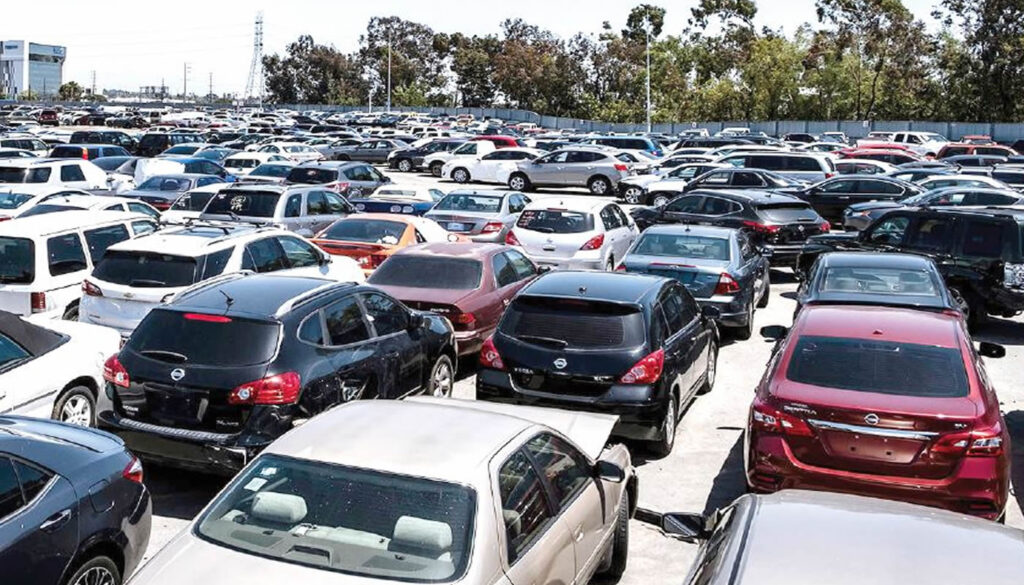 The United States is an important source of used vehicles for Nigerian buyers and importers because of the size of its automobile market and the availability of vehicles through dealerships, private sellers and auction platforms.
A simplified process may look like this:
- Determine the type of vehicle you want.
- Research its Nigerian market value.
- Identify a reliable seller or auction platform.
- Check the vehicle’s VIN and available history.
- Arrange an independent inspection where appropriate.
- Calculate the total purchase and importation costs.
- Purchase the vehicle.
- Arrange inland transportation to the export port.
- Arrange shipping to Nigeria.
- Prepare the necessary documentation.
- Arrange customs clearance and other port processes.
- Transport the vehicle to its destination in Nigeria.
- Inspect and prepare the vehicle for sale.
- Market the vehicle to potential buyers.
The exact requirements and costs can vary by vehicle and shipment, so importers should confirm current customs, port, shipping and registration requirements before proceeding.
Step 4: Verify the Vehicle Before Buying
One of the biggest mistakes beginners make is purchasing a vehicle based solely on attractive photographs.
A vehicle can look excellent in photographs and still have significant mechanical, structural or flood-related problems.
Before buying, consider:
- VIN verification
- Available vehicle history
- Mileage information
- Accident history
- Flood or water damage
- Title or ownership information
- Mechanical condition
- Structural damage
- Repair estimates
- Additional photographs and videos
- Independent inspection where available
If you are purchasing a repairable vehicle, calculate the expected repair cost before bidding.
A cheap vehicle can become an expensive vehicle after repairs.
Step 5: Choose Between RoRo and Container Shipping
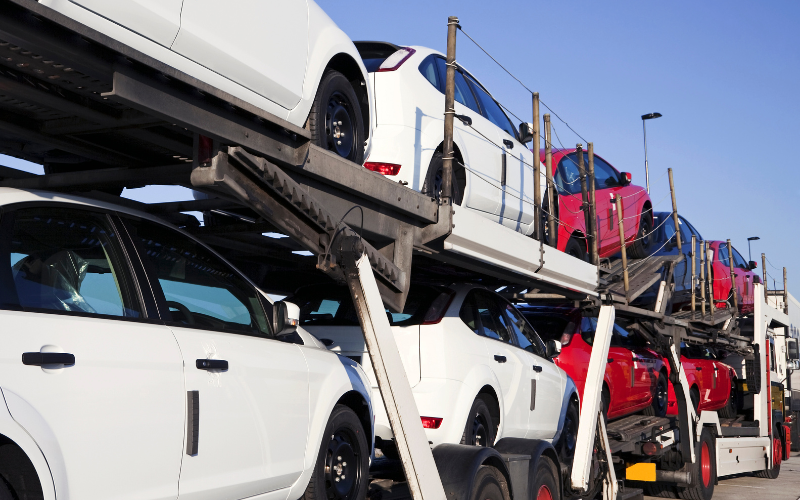 Two common shipping methods are Roll-on/Roll-off (RoRo) and container shipping.
RoRo Shipping
The vehicle is driven onto a specialised vessel and secured for transportation.
RoRo can be suitable for operational vehicles and may be economical depending on the route and shipping conditions.
Container Shipping
The vehicle is loaded into a shipping container.
Container shipping may be useful where additional protection or specific loading arrangements are required. Depending on shipping-line rules and the shipment, multiple vehicles may sometimes be loaded into a container.
The right option depends on the vehicle, shipping route, cost, availability and your business requirements.
Step 6: Calculate the Total Landed Cost
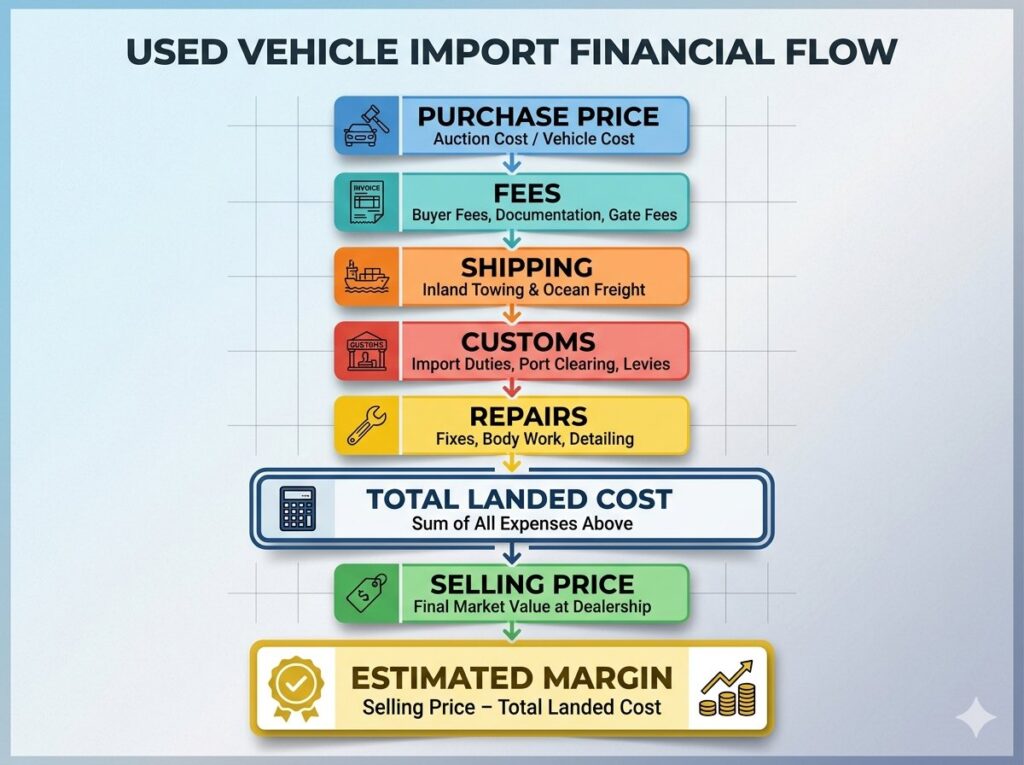 Never calculate your potential profit using only the purchase price.
Your landed-cost calculation may include:
| Expense | What It Covers |
| Purchase Price | Amount paid for the vehicle |
| Auction/Dealer Fees | Fees charged by the auction or seller |
| Inland Transportation | Moving the vehicle to the export port |
| Shipping | Ocean freight to Nigeria |
| Marine Insurance | Optional transit protection |
| Port Charges | Applicable destination charges |
| Customs Duties & Taxes | Government import charges |
| Clearing Agent Fees | Professional customs clearance services |
| Repairs | Mechanical and bodywork expenses |
| Registration | Applicable registration and licensing costs |
| Local Transportation | Moving the vehicle after clearance |
| Marketing | Photography, advertising and promotion |
The goal is to know your estimated total investment before you buy the vehicle, not after it arrives in Nigeria.
Step 7: Understand Exchange Rate Risk
Currency movements can significantly affect an importer’s cost.
If you purchase a vehicle in US dollars while your selling price is in naira, changes in the exchange rate can affect your overall margin.
This is particularly important when there is a significant period between purchasing the vehicle and selling it.
Always factor currency risk into your calculations rather than assuming today’s exchange rate will remain unchanged.
Step 8: Clear and Prepare the Vehicle
After the vehicle arrives, you’ll need to handle the relevant port and customs procedures.
This may involve:
- Customs documentation
- Applicable duties and taxes
- Clearing services
- Port charges
- Transportation
- Inspection
- Repairs
- Detailing
- Registration
Using experienced professionals can make the process easier, but you should still understand what you’re paying for.
Step 9: Price the Vehicle Correctly
Once your car is ready for sale, compare it with similar vehicles in the market.
Look at:
- Make and model
- Year
- Mileage
- Trim/specification
- Condition
- Accident history
- Repairs
- Location
- Current market demand
Don’t simply copy another dealer’s price.
Two vehicles that look similar may have very different histories, specifications or costs.
How to Present a Car for Sale
Marketing is one of the most important parts of the car business.
Before advertising:
- Wash and detail the vehicle.
- Clean the interior.
- Fix practical cosmetic issues where economically sensible.
- Take clear photographs.
- Record a walk-around video.
- Show the dashboard and mileage.
- Photograph the engine bay.
- Show the tyres.
- Clearly disclose known issues.
- Provide accurate specifications.
A buyer’s first interaction with your vehicle may happen online.
Your online presentation therefore becomes part of your sales process.
How Social Media Is Changing the Nigerian Car Business
A physical showroom can be useful, but modern car dealers have another powerful tool: digital marketing.
Potential buyers increasingly discover vehicles through platforms such as:
- Facebook Marketplace
- TikTok
- YouTube
- Automotive websites
A dealer can use these platforms to:
- Display available vehicles
- Educate buyers
- Share inspection videos
- Build a personal brand
- Generate enquiries
- Collect customer testimonials
- Build a database of potential buyers
You don’t need to become an influencer.
You simply need to communicate clearly and consistently.
Why Trust Matters So Much When Selling Cars
A vehicle is a significant purchase for many people.
Buyers want answers to questions such as:
- Is this car genuine?
- Is the mileage accurate?
- Has it been involved in an accident?
- Is it a flood vehicle?
- Are the documents complete?
- Has it been properly inspected?
- What repairs have been carried out?
- Is the seller being honest?
This is why transparency can become a competitive advantage.
If you know about a defect, disclose it.
If you are acting as a broker, say so.
If you don’t know the answer to a technical question, don’t invent one.
If an independent inspection is necessary, recommend one.
Your reputation can determine whether customers return or refer other people to you.
Where Do Nigerians Import Cars From?
Nigerian importers source vehicles from several international markets.
The most appropriate source depends on the type of vehicle, budget, specifications and intended use.
United States
The United States is a major source of Tokunbo vehicles for Nigerian buyers.
Its large automobile market provides access to many makes, models and specifications through dealerships, private sellers and auction platforms.
For people specifically looking for Tokunbo cars, the United States can be an important market to explore.
Canada
Canada is another source of used vehicles.
Canadian vehicles can offer access to a range of makes and models, although buyers should consider factors such as vehicle history, condition, specifications, transportation costs and the total cost of bringing the vehicle to Nigeria.
China
China is increasingly relevant for buyers looking for brand-new vehicles, electric vehicles, commercial vehicles and other automotive products.
Chinese automobile manufacturers have expanded significantly into international markets, creating more opportunities for direct sourcing.
For someone looking for a new vehicle rather than a Tokunbo vehicle, China may offer options worth researching.
USA, Canada or China: Which Should You Choose?
There isn’t one country that is automatically right for every buyer.
For Tokunbo vehicles, the United States and Canada may be relevant markets to investigate.
For brand-new vehicles, particularly some Chinese brands and EVs, China can be an important sourcing market.
Your decision should be based on:
- Vehicle type
- Purchase price
- Vehicle availability
- Specifications
- Shipping cost
- Import costs
- Exchange rate
- Expected Nigerian selling price
- After-sales support
- Availability of spare parts
How Much Does It Cost to Start a Car Importation Business in Nigeria?
There is no single startup figure that applies to everyone.
Your capital requirement depends heavily on the business model.
Someone selling cars on commission may need relatively little capital compared with someone purchasing multiple imported vehicles.
Similarly, importing one vehicle requires less capital than maintaining a large dealership inventory.
Before starting, create a realistic budget that includes:
- Vehicle purchase
- Auction/dealer charges
- Shipping
- Customs and port charges
- Clearing
- Repairs
- Transportation
- Registration
- Marketing
- Working capital
- Unexpected expenses
Don’t use all your available capital to purchase the vehicle.
You need enough financial flexibility to handle unexpected costs.
How to Calculate Your Potential Profit
Suppose you estimate that your total investment in a vehicle will be:
Vehicle purchase + all importation and preparation costs = ₦X
If you expect to sell the vehicle for:
₦Y
Then your estimated gross margin is:
₦Y − ₦X
For example, if the total estimated investment is ₦18 million and the expected selling price is ₦20 million:
₦20 million − ₦18 million = ₦2 million estimated gross margin
However, this does not necessarily mean you will take home ₦2 million as net profit.
Additional expenses, negotiation, unexpected repairs, financing costs, storage and other overheads can reduce the final amount.
This is why a professional importer should calculate conservatively.
Common Mistakes First-Time Car Importers Make
1. Buying Based on Emotion
You may love a particular vehicle, but that doesn’t mean the market will pay the price you need.
Buy based on research rather than emotion.
2. Looking Only at the Purchase Price
A cheap auction purchase can become expensive after shipping, customs, repairs and other costs.
Calculate the total landed cost.
3. Ignoring Exchange Rates
Currency fluctuations can significantly affect the naira value of your investment.
4. Failing to Check Vehicle History
Where information is available, review the vehicle’s history before purchasing.
5. Underestimating Repairs
If you are buying a damaged vehicle, obtain realistic repair estimates before bidding.
6. Choosing a Clearing Agent Solely Because They Are Cheap
Price matters, but experience, communication, reliability and transparency also matter.
7. Buying a Vehicle Without Studying Demand
A vehicle that is difficult to sell can tie up your capital for a long time.
8. Failing to Leave Working Capital
Don’t spend every naira on the purchase.
Unexpected costs happen.
9. Misrepresenting the Vehicle
Short-term dishonesty can damage a reputation that took years to build.
10. Scaling Too Quickly
Buying many vehicles before understanding your market can expose you to unnecessary financial risk.
Start at a level you can manage.
Skills Every Successful Car Dealer Should Develop
A successful car dealer needs more than money.
Important skills include:
- Negotiation
- Customer service
- Digital marketing
- Social media advertising
- Basic vehicle knowledge
- Vehicle inspection awareness
- Pricing
- Financial management
- Relationship building
- Communication
- Patience
- Integrity
- Problem-solving
You don’t need to master everything on day one.
The goal is to keep improving.
Car Business Models Compared
The following table provides a general framework for comparing different entry points into the Nigerian automobile industry.
| Business Model | Typical Capital Requirement | Inventory Ownership | Relative Risk | Potential Income | Suitable For |
| Commission-Based Car Dealer | Low | Usually no | Lower inventory risk | Commission per sale | Beginners with limited capital |
| Vehicle Broker | Low | No | Lower inventory risk | Brokerage fees | People with strong networks |
| Car Sourcing Agent | Low to Medium | Usually no | Low to moderate | Sourcing/service fees | Entrepreneurs with sourcing skills |
| Import One Car at a Time | Medium to High | Yes | Moderate | Margin on resale | Beginners ready to invest gradually |
| Full Car Dealership | High | Yes | Higher | Multiple sales and margins | Experienced entrepreneurs with sufficient capital |
These are broad business-model descriptions rather than guaranteed financial outcomes. Actual capital requirements and returns vary considerably.
Is It Better to Import a Car or Buy From a Local Dealer?
Both options have advantages and disadvantages.
Buying locally can be convenient because the vehicle is already in Nigeria and can usually be inspected before purchase.
Importing directly may provide:
- Greater vehicle selection
- More control over specifications
- Access to overseas inventory
- The opportunity to purchase closer to the original source
- Potentially different pricing depending on the vehicle and total import costs
However, direct importation also involves shipping, customs, exchange-rate exposure, waiting time and other responsibilities.
The right choice depends on your priorities and circumstances.
Can I Import Accident-Damaged Cars?
Yes, some importers purchase repairable vehicles because they may have a lower acquisition cost.
However, this strategy carries additional risks.
Before purchasing a damaged vehicle, consider:
- Structural damage
- Airbag deployment
- Flood damage
- Mechanical damage
- Parts availability
- Repair costs
- Repair quality
- Safety
- Resale value
A vehicle that appears cheap at auction can become expensive after repairs.
Beginners should be particularly cautious and seek qualified inspection and repair advice where necessary.
Frequently Asked Questions About Car Importation and Dealership in Nigeria
Is the car importation business profitable in Nigeria?
It can be profitable when vehicles are purchased carefully, total costs are properly calculated and the vehicle has sufficient market demand. Profit is not guaranteed, and exchange rates, shipping, duties, repairs and selling prices can significantly affect the outcome.
How can I start a car importation business in Nigeria?
Start by learning the Nigerian vehicle market, choosing a business model, researching suitable vehicles, understanding importation costs, finding reliable suppliers, calculating total landed cost and developing a sales and marketing strategy.
How much money do I need to start a car importation business in Nigeria?
There is no universal amount. Commission-based sales and brokerage can require relatively little capital, while importing your own vehicle requires substantially more because you must finance the purchase and associated importation costs.
How can I make money selling cars in Nigeria?
You can make money through vehicle resale, commission sales, brokerage, vehicle sourcing, customer importation services or operating your own dealership.
How can I become a car dealer in Nigeria?
Learn the market, build relationships with vehicle owners and established dealers, understand vehicle inspection and pricing, develop marketing skills and begin with a manageable business model before scaling your inventory.
Can I start a car dealership business with little capital?
Yes. Commission sales, vehicle brokerage and sourcing services can allow you to participate in the industry without purchasing a large inventory.
How can I start a car dealership with no money?
You cannot realistically operate a business with absolutely zero expenses, but you can avoid purchasing inventory initially. You can market vehicles for owners, work as a broker or source vehicles for customers in exchange for agreed commissions or service fees.
How do I start a car importation business in Nigeria online?
You can begin by researching the market, building an online presence, identifying reputable vehicle suppliers, learning the import process, calculating landed costs and using digital platforms to attract customers.
How do I import cars from the USA to Nigeria?
A typical process involves sourcing and verifying the vehicle, purchasing it, transporting it to a US export port, arranging ocean freight to Nigeria, completing the required import and customs processes, clearing the vehicle and transporting it to its final destination.
The exact process, documentation and costs can vary, so current requirements should always be confirmed before shipping.
Where do Nigerians import cars from?
Common international sources include the United States, Canada and China.
The United States and Canada are important markets to explore for Tokunbo vehicles, while China has become increasingly relevant for brand-new vehicles, EVs and commercial vehicles.
What is the difference between a car dealer and a vehicle broker?
A dealer may own or control vehicle inventory and sell vehicles directly, while a broker primarily connects buyers and sellers and earns a fee or commission. In practice, businesses may perform both roles.
How do car dealers make money without owning cars?
They may market vehicles on behalf of owners and earn a commission or agreed margin when the vehicle sells. The exact arrangement should be agreed upon clearly before marketing begins.
What is the best car to import into Nigeria?
There is no single vehicle that is best for every importer.
The right vehicle depends on market demand, purchase price, total landed cost, reliability, maintenance requirements, spare parts availability, customer preferences and expected resale value.
How long does it take to import a car into Nigeria?
The timeline varies depending on vehicle sourcing, inland transportation, shipping schedules, port processing, customs clearance and local logistics. Delays can occur, so importers should avoid making business plans around an unrealistically fixed timeline.
My Personal Advice to Anyone Starting a Car Business
Importing my first Tokunbo car wasn’t simply about trying to make a profit.
It gave me a completely different understanding of how the automobile business works.
I discovered opportunities I didn’t know existed and realized that success in this industry isn’t determined only by how much money you have.
Knowledge matters.
Integrity matters.
Relationships matter.
Marketing matters.
And the willingness to keep learning matters.
I’m still growing in this business myself, and I don’t claim to know everything.
But one thing I have learned is that you don’t have to wait until you know everything before you begin learning.
Start by understanding the market.
Build relationships.
Ask questions.
Study vehicles.
Learn from experienced people.
Start at a level you can afford.
And most importantly, protect your reputation.
A business transaction can give you money once.
A strong reputation can bring you customers for years.
Conclusion: Building a Car Business With Knowledge and Trust
When I decided to import my first Tokunbo car from the United States, I thought I was simply bringing in a vehicle to sell.
What I didn’t realize was that the experience would introduce me to an entirely different side of the Nigerian automobile industry.
I discovered that the car importation business in Nigeria is much broader than importing vehicles and putting them on a car lot.
There are opportunities in vehicle sourcing, brokerage, commission sales, dealership, digital marketing and customer importation services.
I also discovered that starting a car business doesn’t necessarily mean purchasing dozens of vehicles on day one.
For some entrepreneurs, the journey may begin with one customer, one vehicle, one commission or one successful referral.
As the business grows, the entrepreneur can gradually develop the capital, knowledge and relationships required to take on larger transactions.
That doesn’t mean the business is easy.
Importing vehicles involves financial risks, exchange-rate exposure, shipping costs, customs procedures, repairs, market fluctuations and the possibility that a vehicle may take longer to sell than expected.
There are no guaranteed profits.
But for people willing to research the market, manage their costs, build genuine relationships, market effectively and operate with integrity, the automobile industry provides several avenues worth exploring.
My first imported vehicle was therefore more than just a car.
It was an education.
And as I continue building my own experience in the automobile business, I intend to share what I learn—the opportunities, challenges, mistakes, lessons and practical information that can help other Nigerians make better-informed decisions.
Every experienced importer was once a first-time importer.
Every established dealer started somewhere.
And every successful transaction begins with understanding what you’re getting into.
Ready to Start Your Car Importation or Dealership Journey?
If you’re serious about entering the automobile industry, buying a Tokunbo vehicle, starting a car dealership or sourcing a vehicle from overseas, I can help you understand the process and identify the options available to you.
Here’s How I Can Help
Professional Guidance for Aspiring Car Dealers
If you want to start a car dealership business in Nigeria but aren’t sure where to begin, I can provide practical guidance on business models, vehicle sourcing, marketing, customer acquisition and common mistakes to avoid.
Vehicle Sourcing and Importation
If you’re searching for a specific Tokunbo vehicle, I can help you explore suitable sourcing options from trusted suppliers in the United States and provide guidance on the importation process.
Personalized Vehicle Search
Tell me the:
- Make
- Model
- Year
- Budget
- Colour
- Preferred specifications
- Intended use
and I can help you identify vehicles that match your requirements.
Importation Support and Advisory
If you’ve decided to import a vehicle but need guidance on the process—from vehicle selection and verification to shipping, clearing and arrival in Nigeria—I can help you understand the different stages and identify the areas where professional support may be required.
Car Importation & Dealership Consulting
Whether you’re interested in becoming a vehicle broker, commission-based dealer, importer or full-time car dealer, I can help you understand the different models and develop a practical starting point based on your resources and objectives.
Let’s Build Your Automobile Business With the Right Information
The right information can save you time.
The right research can help you avoid expensive mistakes.
And the right vehicle can make a significant difference to the economics of an importation transaction.
Whether your goal is to:
Start a car dealership with little capital,
Learn how to import cars from the USA to Nigeria,
Become a car dealer in Nigeria,
Source a Tokunbo vehicle,
or build a car importation business in Nigeria,
you don’t have to begin by trying to do everything at once.
Start with knowledge.
Build your network.
Understand your numbers.
Protect your reputation.
Then grow from there.
Car Import Consultant & Vehicle Sourcing Specialist
Car Importation & Dealership Consultant